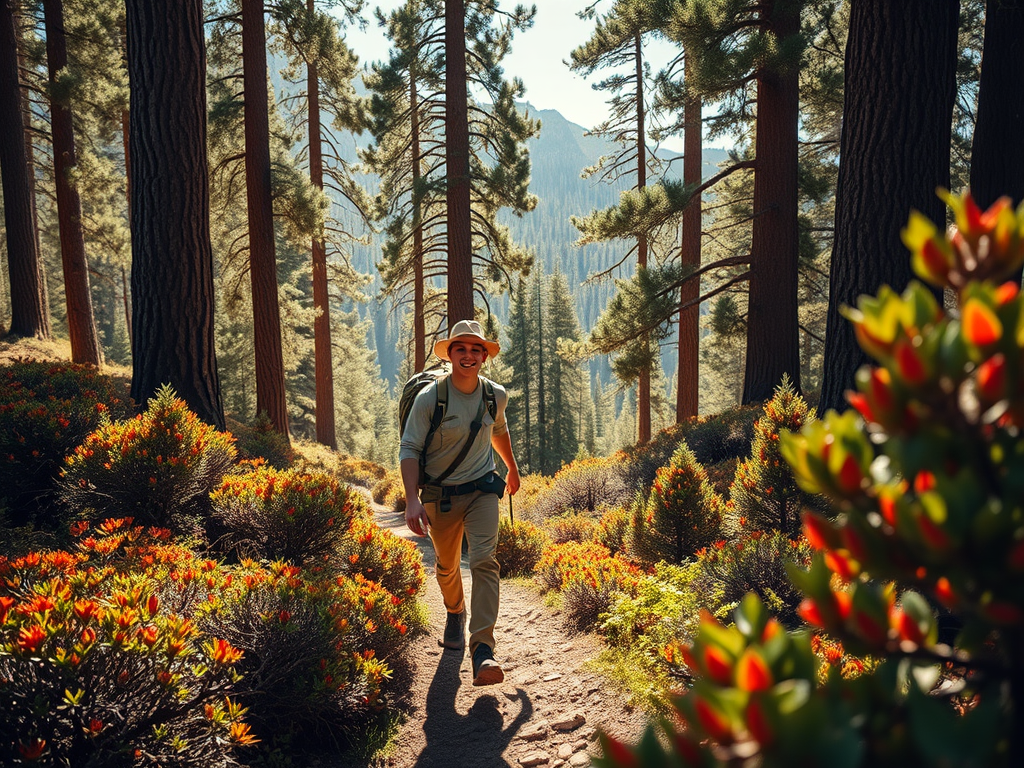
It was the end of my time at the Cal Berkeley School of Forestry. Classes were ending. Graduation was coming up, and with it, my trip to the south to work as a pathologist on a long-running Forest Service/Cal Forestry joint research project. I was actually going to miss going to school. I was just getting the hang of it and actually managed a few A’s in my final couple of quarters. My parents came to my graduation. My wife did not attend her ceremony, so her parents did not come to the graduation. She was continuing to higher degrees anyway, already getting into her master’s program and research. I was packing up to drive to San Bernardino to spend the summer as a forest pathologist.
Our base camp in San Bernardino was at Big Bear Lake, at the Timberline Lodge. There were two crews, each one with a lead forester, a pathologist, an entomologist, and a smog rater. The project involved driving to an initial plot area and hiking to a designated dead tree noted on aerial photos. We would then rate the area for overall cover and forest type, and try to determine the causal agent in the tree’s death. The smog rater would choose a few live trees in the area and rate them for smog damage. They were trying to relate smog damage to the trees’ weakness and, by extension, to a specific problem that had caused the tree’s death. The project had already gone on for a couple of seasons before I joined. A couple of years later, I heard the data was all in a bunch of boxes waiting to be analyzed. As far as I know, it is still waiting. The program had lost its funding by then.
The first thing I realized after starting this job was that I really wasn’t in good enough shape to hike in high-altitude heat and smoggy conditions. No wonder the trees were dying. They lived in a pretty close approximation of hell. This lack of conditioning first showed itself when I was always the last person to reach the site we were hiking to. This was not a real concern, though. I am sure someone is always last, and I was used to it. It didn’t occur to me then, but the rest of the crew had already arrived before I had. They had a chance to acclimate to the heat and altitude. I didn’t.
Where my lack of conditioning became a problem was fairly early on, when we were hiking out of a site back to the jeep for lunch. The “trail” to this particular site was extremely steep. Since the others on my crew had been there the year before, they were more used to the terrain and heat than I was, so they made a game of it on the way out to see who could be the first one out. Of course, that left me behind in an area of 7 ft high manzanita.
I was OK at first. There was a narrow path. But it did not take me too long to get into trouble. I missed a turn, and suddenly the path that had been small to begin with was completely gone. I could hear them ahead, so I assumed they had to have gone this way. I was wrong. I struggled a bit in the brush, then realized I could no longer hear the other crew members.
It must have been near 100 degrees, or it seemed so anyway. There was an ongoing smog alert. When was it not smoggy here, I wondered? I was literally in over my head. I had trouble moving forward. I had trouble moving back down the way I had just come. And since I knew at this point that I had missed something, I figured I only had one direction that made any sense to me, and that was up. Going back down or to either side would just tire me out more, or I might be going away from a clearing or the resumption of the trail.
I called out, but they were too far ahead to hear me. The water in my canteen was so hot that it did nothing to quench my growing thirst. I realized that I had stopped moving at all, and the thought crossed my mind that I might just die out there on that hill. Even knowing that, I did stop. It took all my will to start up again.
Somehow, I got up the strength to push on uphill through the head-high manzanita. At times, I was up in it, actually off the ground. It made it a bit easier to see ahead, but not being on the ground is also harder on your feet. My legs were already weak from this struggle, and I was starting to hyperventilate. Something at this point must have taken over. I really have no idea how I got through it, but suddenly I was free of the brush. There was still no path, but I just kept climbing. Eventually, I got to the top of the climb. I had no idea at that point which way to go to our jeep. I just started walking. And I use the term loosely. I was dead on my feet. My legs were barely moving, feet dragging. I knew I was breathing too shallowly and was losing control of how I was breathing, but I had to keep going.
All of a sudden, I walked into a clearing, and there was the jeep. Everyone ran over to me. I went to the ground, grabbing into my vest for a sample bag to breathe into. I got hold of one, and they took it away from me. Next thing I knew, I was in the back seat of the jeep, and they were driving like a bat out of hell to a hospital. In the back seat, I knew I needed to breathe into a bag, but my extremities were so numb at that point that I could not get one. I must not have been able to talk to them, because I would have told them what I needed. Finally, we get to the hospital, and the first thing the nurses did for me was put a bag up against my nose and mouth and tell me to keep breathing as normally as I could. I knew what I needed. My crew had already let me down, and when I tried to fix my problem myself, they just let me keep hyperventilating. Some crew I had there.
My breathing got better, and my numbness disappeared. When the hospital crew was sure I could function, they let me go. Work for that day was done. It was a Friday; time to rest for the weekend. My crew had some phone calls and reports to make about what had happened to me, and how they would ensure it would not happen again. No one ever asked me my side of it. I would have told them my crew members had left me in the canyon and had failed to make sure I was behind them. Then they had continued to the jeep as if nothing was wrong. I was surprised I had made it to the jeep. I had no clue where it was compared to where I came up out of the canyon. Evidently, they had been honking the horn since they realized I was not right behind them. I had been so out of it that I had no memory of hearing anything.
The summer continued. Later, we had to go back to that plot to re-take certain data. It was equally hot and smoggy. Some things had changed. Now, there had to be someone behind the person least able to keep up with the group. They made jokes about me keeping up with them on the way out. But I was no longer the weakest of the group.
I was acclimated by then. I kept so close to my “leader” on the way out that I was literally at his heels. He knew I was right there, and the competitive instinct of this clown made him go even faster. I kept up with him, no matter how fast he went. When we got to the top, he doubled over, hands on his knees, panting. I stopped for a moment to ask if he was OK, then kept walking. Either my conditioning was improving, or he was drinking way too much beer after work.
 Memory is the Key