Monday, June 15, 2020
I have joined the Weather Underground. Not the militant radical one found here: https://en.wikipedia.org/wiki/Weather_Underground, but this one: https://en.wikipedia.org/wiki/Weather_Underground_(weather_service), an internet-based weather service that uses weather information from volunteer weather station operators. Although both originated at the University of Michigan, that is where the similarity starts and ends.
Since I was a kid, I have always wanted a high-quality home weather station that didn’t cost a fortune. The professional/serious hobbyist models start at $1000. The one I have now is nowhere near that expensive, but if I added up the money for all the cheaper ones I have bought over the years, it would no doubt equal one expensive one. Or more.
I have been interested in weather since I was a kid. And in response to that interest, Santa brought me my first weather station when I was young enough that I still hoped Santa was real. I can blame “Santa” for my obsession.
It was one of the better things “he” ever brought me. It wasn’t just a weather station, it was a science kit/leaning tool. I had to assemble each sensor and wire them into the console. Even getting that far, it wasn’t easy to view anything it was telling me. I had to count flashes of a red light to calculate wind speed and use a wet-bulb/dry-bulb calculation to find humidity. It was inaccurate as far as any real current conditions went. But I had fun building it and learned a lot. This wasn’t the sort of “toy” Santa ever brought to my brother or sister. Maybe he had seen I had some sort of talent I had not realized at the time.
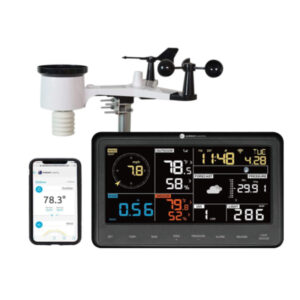
As I continue to explore old hobbies that interested me long ago, I again find that the pace of technological change and the relative decrease in the cost of weather stations over the years are phenomenal. The current weather station I chose is exponentially better than the initial gift from Santa or any of the other brands I have had limited success with setting up over the years. It is an Ambient Weather WS-2902B Osprey. The main sensor array is solar-powered during the day and uses a slow-discharge capacitor at night. For days with too much cloud cover, it has a battery backup.
It has about every weather sensor you could want. Assembly was minimal. It has an indoor display console and can connect to the internet. Of course, that was my main goal. I have it open on my computer as I write. Being a total weather geek, I was excited to see my station listed for the first time on the map of other stations in town. By connecting my personal weather station to http://www.wunderground.com, I have joined more than 250,000 other weather hobbyists who are supplying local weather conditions across the country. I have a phone app that lets me check the weather in my backyard wherever I go. And the Weather Underground people use my data and that of others to help produce more accurate forecasts.
This was a bit of trouble (it’s me, and this is how things go). I started with the station mounted on a stand on my deck. That seemed to reflect too much heat from the house, so I moved it 100 feet out into the yard, where it is surrounded by tall grass and short shrubs. It should be a perfect spot. But it is still a bit on the hot side. Now I see that for $100 more, I could have had one with a fan to draw air into the temperature and humidity chamber for use in hotter, less windy climates. Now they tell me.
Maybe next time. Or maybe next time I will spring for the $1,000 level.
Update- Prior to this being published, I had noticed a “Gold Star” emblem had been added to my station readout. Wondering about this, as I tend to do about everything, I found that this is a notice from Wunderground that my station has passed their quality control and is now one of 20,000 stations used to generate Forecasts on Demand.
From their information-
1. There are 200,000+ observations per minute ingested
2. QC every 10 minutes to remove bad data
3. Current conditions available on mobile, web & API
4. 20,000 Gold Star stations’ data used to generate Forecast on Demand-
 Memory is the Key