When I was younger and living in San Rafael, my father occasionally serenaded us. He played guitar and sang. Most often, it was songs by Jim Reeves or Hank Williams- people like that. I say serenade us, but we were not always in the room. The sound carried to all parts of the house. Other than Reeves or Williams, one he played and sang that we all liked went like this,
“Whiskey, Rye Whiskey, Rye Whiskey I cry.
If I don’t get Rye Whiskey, I think I will die.”
Here is Pete Seeger’s version of Rye Whiskey.
Tex Ritter did it more the way my father did; see that here.
This was a favorite. There is a part where the singer howls in a drunken stupor. Then, he has a pronounced “Hiccup.” The way he did it always made us laugh. We gathered to clean his apartment after he had died. My brother, sister, and I sang it again. We sang it just the way he used to.
Listening to my father sing was entertaining, but sometimes you wanted to escape it. The repetition of the songs could get tiresome. This was especially true if he was attempting to learn a new one. As far as I recall, my mother was almost always in the room. He needed an audience, even if it was only one person. A couple more listened, even though they were trying to do other things.
One of his other favorites was “Tumble-weeds.” This is the Sons of the Pioneers version. My father always sang it alone. But once, when my brother and his son visited him, they worked up a version in three-part harmony. My father later played a tape made that day for me over the phone. It sounded as good as any time I have heard of it done professionally.
My father played the trumpet as a kid, and I remember him playing when I was young. I think he gave up on it, though, after losing his two front teeth in a minor traffic accident. Having tried to even get a sound out of it, I can understand why it had to be given up. After he died, we were visiting our aunt. She told me how he had just picked up an old trumpet as a kid. He started playing it one time. She said she was out in the yard one day while my father was playing the trumpet. She told me a neighbor stopped by to ask her who was on the radio. She said, ‘That is not the radio; it is my brother.’ As I remember, he sounded like he knew what he was doing. How he learned to do this, I am not sure. I don’t think they had the money for any kind of lessons.
My mother was also musical. She played flute in High School, but she was not quite the exhibitionist my father was. She would play occasionally when we were younger. However, she usually did not participate in any family gatherings. We also had an old, beat-up piano that everyone banged on from time to time. We grew up among these instruments. It was only a matter of time before we started to get interested in playing something ourselves.
My sister was the first of us to officially pursue a musical endeavor. Elementary schools still had music programs at this time. The big thing to start with was the violin. She got one of the violins from her class and was off. We would hear her in her room practicing. She also tried to play the piano after learning the basics of music. As she grew older, she transitioned to the viola. She got up very early for school so she could go to practice. She would attend a full day of school, come home, do her schoolwork, and practice some more. I remember attending many concerts where she played.
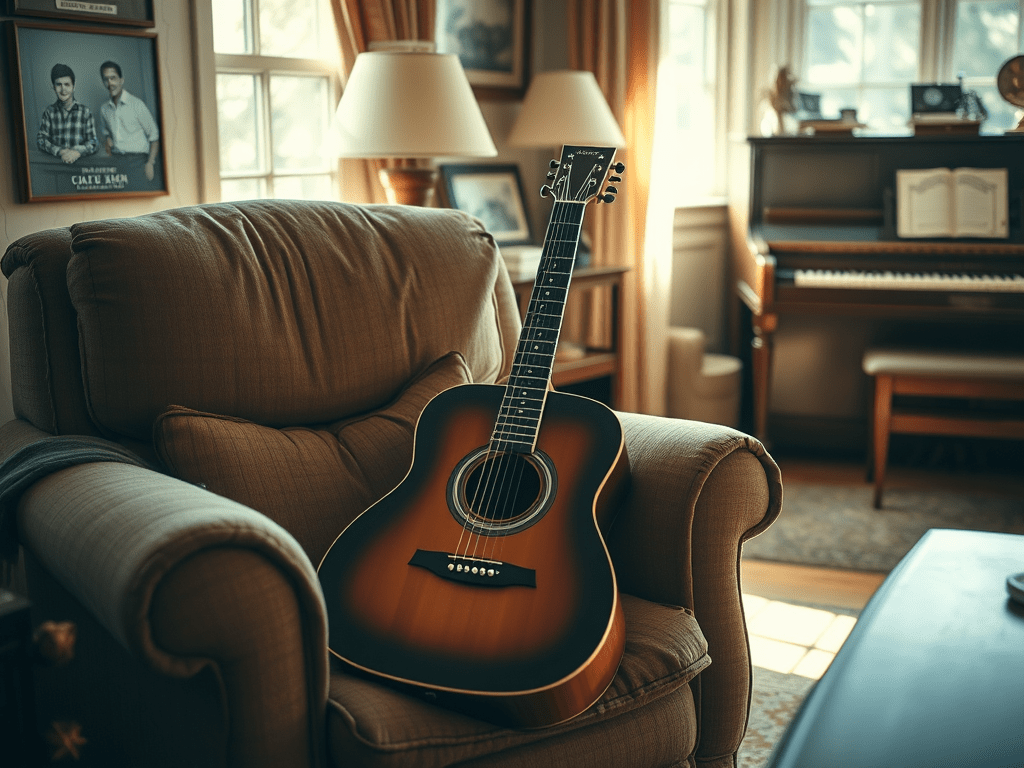
My brother was not interested in the violin, or maybe he was. But he took a different path from my sister. He was more interested in my father’s guitar. Initially, this was an old Harmony archtop. When my father found a used Harmony Sovereign at a pawn shop, my brother inherited the older model. They even sent him to an official lesson. Eventually, my brother got an electric bass guitar for his birthday. Soon, he joined a rock band with a couple of friends. They actually played and won a local “Battle of the Bands” and also played at my seventh-grade dance.
My brother went on from there, of course. He eventually got a tenor banjo for his birthday. He was disappointed that it wasn’t the five-string banjo he had asked for. As a result, he never took it out of the case. After the rock band split up, he joined a folk group where he served as the guitarist. They did a few regular folk songs and some novelty songs. They had fun playing, but it never went anywhere. Rock bands were still in demand, not this type of stuff. By college, he had gotten himself into a bluegrass band playing guitar. They played at pizza restaurants and one time opened for Doc Watson.
Where was I in my musical upbringing? Nowhere. For some reason, no one was interested when it came time for me to get my musical instruction. No one wanted to get roped into spending money on a school-sponsored violin. When I picked up the guitar, no one wanted to show me a few chords. They were not interested in my attempts to make music. I knew nothing about music. No one figured I was really interested enough to actually stick to learning anything.
I am not sure why no one took my interest seriously. Sitting and listening was the closest I could get to doing anything related to music. I listened to my father, mother, and sister with her various orchestral offerings and a succession of my brother’s bands. Occasionally, with my brother’s group, I was responsible for adjusting knobs and pushing buttons. I recorded the session on a tape recorder. But that job was only needed when they practiced at our house. No one seemed interested in my desire to learn to play anything seriously. They didn’t let me decide how serious I wanted to be. What about that neglected tenor banjo my brother had? He wouldn’t let me use it even if he had no interest in it. If I were to do anything musically, I would have to do it alone.
There was one time we got together and did something musical. My sister was not there because she had moved out to attend college. Among the other musical interests mentioned, my father sang in barbershop quartets. (One of the groups he was in agreed to sing at my wedding, discussed elsewhere here.) There is a song that quartets sing as a novelty piece. It is called the “Nursery Rhyme Song.” It comprises four nursery rhymes, one for each singer and all in different melodies. These interlace in an intricate manner when sung. One part by itself is not particularly interesting. But when taken together, the parts form a really neat-sounding, albeit very short, song in barbershop harmony.
My father was the baritone. My mother would have been the lead. My brother was the bass, and I was a falsetto tenor. I say falsetto because my voice had deepened at an early age. I could control it well enough at a range much higher than my speaking voice would suggest. It took us hours to get the parts right. Then, for hours more (or it seemed), we sang it all together. We continued until the changes and interlaced lines merged correctly. It was a lot of fun, one of the more enjoyable things I remember doing as a family. Then, we stopped for the night, and we never did that or any other singing again. Here is a link to a group doing this song. It’s not exactly how we did it, but you get the idea. Our version did not include the cheesy choreography. We also skipped the short rendition of the Mickey Mouse Club theme song at the end.
My father returned to his childhood home for a funeral. He brought back a small tenor banjo. He had had it as a kid. It was dirty, scratched, broken, and generally unplayable. That was the instrument I was given to express my musical talent. This reminds me of another thing. The first camera I got was old and broken as well. I had to prove my interest in anything by receiving a broken item. If I could fix it, I was allowed to keep it. I fixed the camera, but I will never know how.
I took that banjo apart. I cleaned it up and refinished it. Then I put it together again. This way, I could play whatever music it might still have in it. It really was not an instrument of any high quality. It was not something that anyone who knows instruments would have taken the time or money to repair. That is what I had at that point. The funny thing is that I discovered a way to play it.
Initially, I tuned it as a regular tenor banjo. I attempted to play it using real tenor banjo chords. I found these chords in a tenor banjo songbook. I could do that, but it was boring. Then, I discovered what is known as open tuning. This was a bit easier and seemed to be more versatile. What I really needed, though, was a 5-string banjo that was more suited to this open-style tuning. Pete Seeger had a show (Rainbow Quest) on the local educational channel, which is now PBS. I would watch him. I observed how he played. I purchased an affordable 5-string banjo. I found it in a music store in San Francisco. I was off to a good start. Soon, I developed my version of how Pete Seeger played, closest to a style known as “Claw-Hammer.” I created my own version of how others played. I wasn’t sure if it was a genuine style. I could play similarly anyway.
I liked regular bluegrass 3-finger picking at the time, too, but I could never get the hang of that. So, when I played, people thought it was interesting. But it was not what they typically heard from a banjo. It was different from the theme song of “The Beverly Hillbillies.” They were not very interested for long. I was okay with that, though. I was finally playing a real instrument, even though I had to wait until I could afford one.
Eventually, I purchased a guitar from the same music store where I had bought the banjo. I learned to play it, too. I was not really proficient. However, I was passable. I had no real encouragement and no music training. This probably limited me, but it also let me experiment with different ways to finger-pick or tune it.
My brother had always been a pretty good guitarist. As a kid, I had listened for hours at a time. He played the same song repeatedly. With my own guitar, I learned to play much later. I reached a point where I could play a version of this same song my way. I played it ( Suze (The Cough Song) – Bob Dylan) for him once. He was surprised and asked me where I had learned it. I told him it had just come to me and that I finally remembered that he had played it. I could never tell how he used all four fingers and his thumb. He looked at what I was doing. He could not figure out how I was getting a very similar sound to his. I managed this with only two fingers and a thumb.
This was a fun time for me, and I got to play guitar with him. I played one other thing that he did not know I could play. I started playing my version of it (Hard Hearted Hannah (The Vamp of Savannah), and he came in playing his. (I am not suggesting that I was as good as this linked version. If I could play like that, I would have quit my day job.) It was the same song, just done slightly differently. We played it that first time, and it blended really well. He asked where I learned to play it that way. I said it was from memory of listening to how he had done it long ago. Of course, living as far away as I did was not conducive to this sort of get-together very often. In fact, it never happened again.
I occasionally played with other people. Nothing really serious. I was just jamming with an old high school friend. When I was a messenger driver in San Francisco, I would play with one of the other drivers after work. We jammed when we were not drinking. I was into it even when I was not playing. I watched other guitarists closely. I looked for anything new I could add to my own technique.
During this period, I decided I could afford a better banjo. I upgraded and sold my first one for almost what I had paid originally. I continued playing, just for my own enjoyment. I seemed to stagnate in what I was doing, though. I reached a point where it seemed I was just doing the same things all the time. When I arrived at my current home, I purchased a mandolin at a pawn shop. I thought it might add a new wrinkle to things to try something different. It helped for a while. I never got to the point where I could do much on the mandolin. Maybe a better one would change that, so I traded up, selling the original. I think the original actually was a better instrument. I should have kept it.
A few years ago, I bought another guitar. It was an upgrade from my original, but as it turns out, I have not played much since then. Partially, this is due to a neuropathy. It makes my fingers not go where I want them to. They don’t go when I want, or hold the chords as tightly as I need to. It is hard to pick with a thumb that does not move correctly. My current lack of coordination between my left and right hands is irritating. I seem to have lost interest in continuing, at least as often as I used to. My parents were probably right. I never would have kept up with an instrument.




 Memory is the Key