November 01, 2020
November 8 will mark two years since the Camp Fire occurred. It burned most of the town of Paradise off the map.
Judy and I were there that morning. We shouldn’t have been. We didn’t know what was happening. I relied on my phone’s warnings to alert me that we were driving into danger. Residents in Paradise had been told that the fire was far away and moving away from them. The warnings I waited for were never sent. The fire was moving way too fast. Even if we had checked before leaving home, we would likely have been told it was fine up there.
We attempted to go to Paradise that morning because Judy had an appointment. Her appointment was at the Feather River Cancer Center.
When we went out to my car, I could tell that something about the sun did not look right. Before I realized the strange light was caused by smoke, I told Judy I hoped we could even make it to her appointment. We had tried weeks earlier to get a quicker appointment based on the speed at which her lymph nodes were growing. We had been turned down. That made it more important to get up there, or at least to try.
Once we were on the freeway starting the trip, we had a better view of the smoke. Of course, I could not tell its relation to where we were going. I know, we should have pulled over and called ahead. From what we later found out, they were either already gone. Alternatively, they might not have had any information about the fire’s location. The residents had been told early on that Paradise was in no danger. Nothing looked out of the ordinary except for the smoke. As we got closer to Paradise, everyone seemed to be doing their usual activities. We always observe these activities when we head up there. The smoke was ominous appearing; I could hear ash falling onto my car. But people were out in their yards seemingly unaware of anything out of the ordinary.
On Pearson near Pentz Road, it even got sunny for a stretch on the way up. I remember telling Judy that maybe the fire wouldn’t be a problem after all. We turned left from Pearson to Pentz, and it was like entering a nightmare. We had not seen any first responders the entire trip up. That is because they were already up along Pentz.
We turned in at the Cancer Center; a guy was there with his Smartphone. He motioned for us to stop. “Whatever you are here for, it is canceled. They are evacuating the hospital. Follow the road down and to the left, and back up to Pentz.” I looked in the direction he pointed. The fire was just then coming up over the edge of the canyon. It seemed to me it would have been easier and quicker to turn around right where we were. And safer. I decided he must have a good reason to keep that entry clear. So, I drove down to the edge of the canyon. I had never stopped there to take in the view before this, and I did not stop now. I knew exactly what I would see if I got out to look. The fire was that close.
Our trip back down Pentz was more harrowing than it had just been a couple of minutes earlier. There were the beginnings of burning embers blowing across the road as we made our way to Pearson. I had a choice: turn right onto Pearson or try to get back down along Pentz. Pentz followed along the edge of the canyon for a while. I didn’t know the fire’s exact location. Therefore, I decided to turn right back down Pearson. I knew that traffic would probably be gridlocked this way. However, I also knew that no matter how slow we might be going, it would take us away from the fire. A quarter-mile or so down Pearson, where it had been sunny just a few minutes earlier, it was as dark as midnight. And the traffic was stopped. A sign that had not been noticeable there a bit earlier mocked us: “Evacuation Route.” The arrow pointed downhill. That much was a plus.
This section of Pearson has a couple of ridges it crosses. The traffic had stopped at the bottom of a switchback on the downhill portion of the first ridge. The hilly terrain here may have saved us. But from what I heard later, the fire was much closer now than I realized. It was just being blocked from view by the ridge. It was a two-lane road here, and the uphill lane was periodically taken over by a first responder headed in the direction of the fire. Checking the rear view mirrors, the smoke had a reddish glow.
Then, suddenly, a caravan of emergency vehicles would head downhill. I later realized that among these vehicles, was the remaining group of workers evacuating from the hospital, having been rescued after a Cal Fire Bulldozer operator had taken matters into his own hands and pushed broken down cars off of Pearson Road. As I said, it was happening much closer to us than I had known at the time.
Overall, I remained calm. It would not help at that point to lose control. And since Judy had pretty bad anxiety around that time, I knew I had to make things seem OK, even if on the inside everything was telling me it was otherwise.
At one point when traffic had barely budged on a flatter section of Pearson for what seemed like an eternity, suddenly I saw this young guy was skateboarding along the side of the road just like all of this was an everyday experience for him. I turned to Judy to point him out to her, saying, “Now, there is something you don’t see every day.” If we hadn’t been in this situation, I might have started laughing. Nothing we had seen so far fit the category of being an everyday sight in any way. Judy was beyond noticing him. Wherever she had escaped to, I let her stay there. I had to stay alert throughout it all. Everything seemed out of sync with reality.
There wasn’t much of anything we saw that would fit into a normal “everyday” experience. Just down from the skateboarding guy, we saw a group of four men standing out along the road drinking coffee. Just another leisurely morning drinking coffee with the guys. They didn’t seem to have a care in the world. It could be that they did not yet know why we were all out there. Or they were waiting for the traffic to clear so they could join it. Someone ahead of us must have asked them if they knew a shortcut to get back to Skyway ahead of the traffic. The men pointed out the directions and talked to the people in the car. The car turned off at the next intersection. Judy and I knew, though, that there would be no shortcuts out of Paradise now. We stuck to the designated evacuation route. Well, I knew anyway. Judy wasn’t talking at this point.
It was nerve-wracking barely inching along in traffic when I knew the fire was advancing on us and it would not care if the traffic wasn’t moving. We were lucky. We managed to stay ahead of the main fire. I kept watching the rear view mirrors, both for fire and for people passing in the uphill lane. There were just enough first responders still coming uphill that made me worry- what if that guy forces his way back into this lane and causes an accident in front of us. Or, what if the fire “spots” to a place ahead of us and cuts off our escape route?
By the time we got back to the Skyway, I could see that the fire had “spotted” into the Butte Creek Canyon side of Paradise. We knew people who lived there, just as we knew many people in Paradise. The guys directing traffic at the intersection were noticeably frantic. I could see on their faces that they were completely aware of the location of the fire and that we needed to get moving. Very glad to oblige if you can get these guys in front of us to cooperate.
Just as we were getting to the intersection, they must have received the OK to open all four lanes for downhill use. Judy requested to stay on the usual downhill side. That was fine with me. I know that if she had to face one more out of the ordinary thing on this trip, she could go over to a full-blown panic attack. As it was, I wondered how she was managing.
We had a brief period of faster traffic before the Chico congestion backed up on us, but I was pretty sure by then that the fire was not going to catch up with us. Judy later told me we had stopped 12 times on the Skyway due to heavy traffic. Thinking back, I know I was more concerned about the stops back in Paradise. I think she must have blocked the memory of that part of the trip.
I could tell by looking at the smoke in the rear view mirror that the fire was bad behind us, but I never saw the flames then. . . Overall, we did OK on the trip down. We never should have been up there, but I am happy that we got out without any long-term impacts.
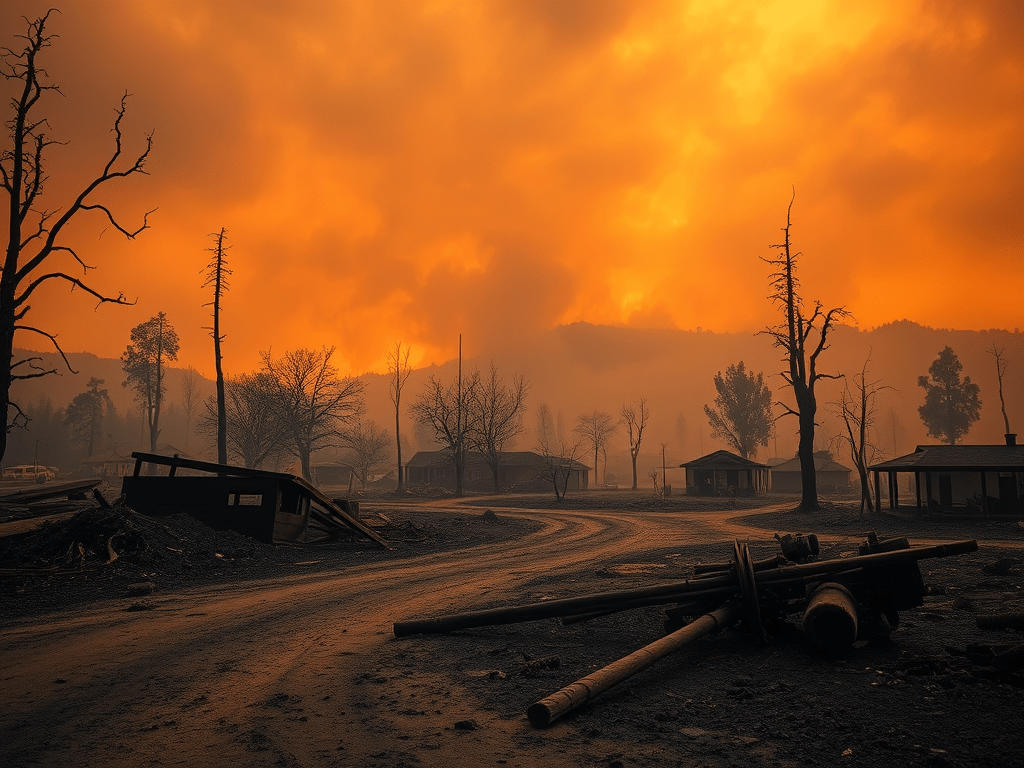
The next day, when we woke at seven, it was still dark. The sun should have risen around 6:45. Judy didn’t want to go out, but I knew we had to. I needed to get her out of the house or she might go into a depression it would be difficult to overcome. As we drove downtown to our usual spot for coffee at around 10 am, it still looked like midnight. I drove with my headlights on. All of the streetlights were still on. We didn’t see the sun at all that day and most of the next. It was the first of many days to follow when nothing would be normal.
As sick as Judy was by then, she still opened up our home to take in a couple we knew who had lost everything in the fire. They moved on again as soon as they could. They could tell Judy wasn’t well enough to have house guests for any reason, even though they needed the place to stay.
Judy and I returned to our daily trip to our favorite café. The fire was still burning, but firefighters were making progress, especially on the main fire break between Paradise and us. The conversations we heard or took part in were about the fire.
On one such day, Judy and I sat at a table near the front entrance. My view allowed me to be the first to see a group of five Cal Fire personnel walking towards the entrance. I stood up and opened the door for them. As they filed past me, I started clapping. People already at tables turned and saw them. Soon, everyone in the room had stood and started clapping and cheering. I was close to tears. There are still issues I have to work through.
The ranking firefighter came towards us after getting his coffee and told me and Judy that it was their honor to serve our community and thanked us for being there. “There is nothing that special about us,” he told us. “We are human, and it gets to us too. Last night, when I was taking a shower, I broke down.”
“We were up there the morning it started, I said. “And even though we didn’t lose property, I have lots of issues about just being caught in the evacuation. I was close to breaking down ever since I saw you come in.”
Healing is a long-term thing for first responders and victims of trauma.
Around that time, it had become apparent that Judy’s doctor would not be seeing patients here in town for a long time. I had suggested she should switch to a doctor in Chico. She said no. And her Paradise doctor eventually relocated to Chico. But things like this don’t happen overnight. There was quite a delay in her treatment. And maybe this delay had no overall impact on her. But it couldn’t have helped matters.
I still haven’t been back to Paradise. I have no real need to be up there at this point.
It is a funny thing about being in that evacuation. I had seen many television news videos of people trying to outrun a wildfire. And I usually yelled at the TV, “What the hell were you even doing up there!?!” Now, I knew. It was just bad luck. You don’t have to seek opportunities to be in the way of things that can kill you. Life is enough to provide them; it doesn’t need your help.





 Memory is the Key