Saturday, June 6, 2020
Somewhere back in time, shortly after meeting my wife Judy, I told her that I had always wanted to be an amateur radio operator. This was in part due to one present from “Santa” when I was a kid, a cheap pair of walkie-talkies that worked fine if the two users were still in normal hearing range of each other. In other words, they didn’t work at all. But they did receive an amateur radio operator somewhere in the neighborhood. “KC6DNQ calling CQ 10 meters . . . Kilowatt-Charley-6-Denver-Norway-Quebec calling CQ and listening.” I wanted to know who this was, but more what he was trying to do. What was CQ 10 meters, and why was he calling it? My father was a bit savvier in his earlier years, knew this was an amateur radio operator, and the next Christmas gifts included books on radio theory and Morse code, required to get a novice amateur radio license. It took many years to get up the nerve to take the course. And it took a bit of a nudge from Judy.
Back then, Judy commuted by bus to a hospital where she was a physical therapist. She heard from one of her bus-mates that they would be offering a novice amateur radio class at the college soon. I signed up. I had always shied away from trying this before because of the code requirement. It was only a five-word-per-minute test you had to pass, but starting from zero words, it might as well have been 100 words per minute.
There was also a theory portion. That was easy because I was more interested in that part. In the end, on test night, I just barely passed the code portion. And I remember I only passed because I was able to hear part of what had been sent and guess the rest. More important to me than how I passed (barely) was having my amateur radio ticket. And I got it before the FCC dropped the code requirement, a distinction that was important to me because I wanted my license before that requirement was scrapped, and I would always know my I received my license when that was still required.
For the most part, I never had time to devote to the hobby since then. I had noticed that most of the amateur radio hobbyists I met then were retired. I was barely 30 then. But now I have the time, and I am more or less retired.
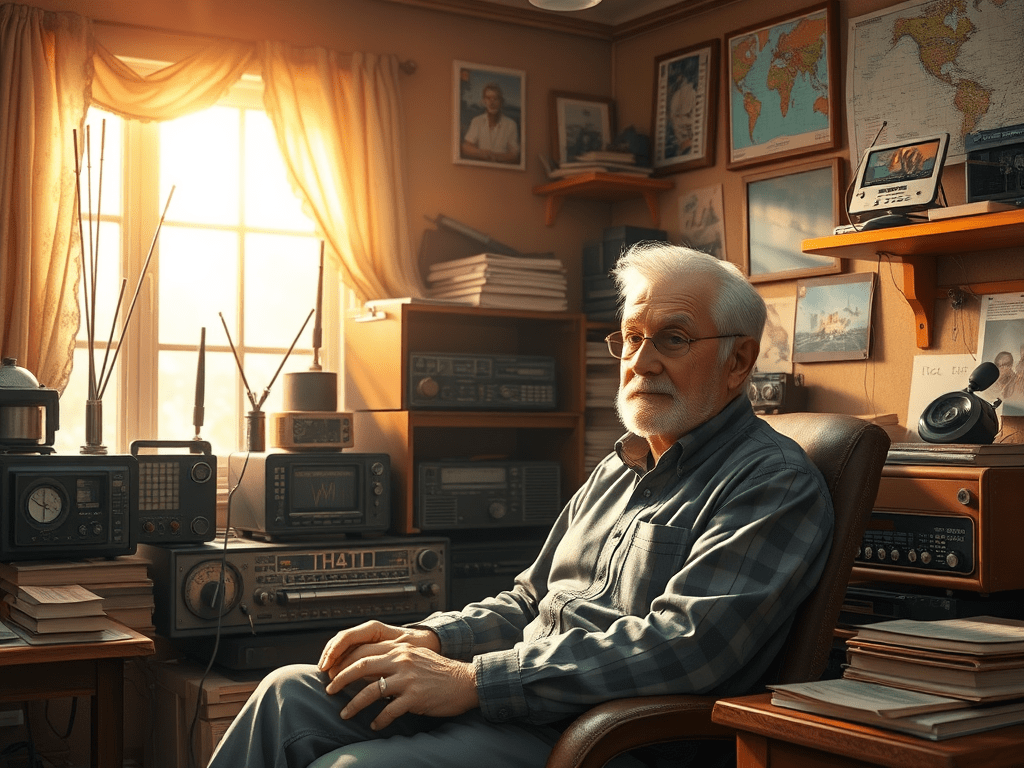
Anyway, earlier I dug out two of my radios (three if you count an old CB radio, I bought the day of my Technician test, that was doctored to work on the ten-meter band (as in CQ 10 meters). I actually was able to talk to someone in the Philippines back then. But I am rapidly remembering, there is no such thing as a cheap walkie-talkie. Who knew?
Back then, things were quite active. The people I knew in amateur radio were retired. Judy suggested at some point that maybe I would have more time for it when I retired. Oh well. It turns out she was correct about that. But, so far, everyone is gone, retirement age or not. I have only sampled a couple of the two-meter “repeaters,” as they are called, but they used to be very active on the VHF frequency range. Now the only voice I generally hear is the repeater ID.
To hear anything at all, I had to operate on two of my Alinco radios, a DR600 and a DR1200. Frequency memory was maintained by a battery for those back then, said to last for five years. It has been more than twenty years since I had used either of them, so both batteries had to be replaced, a simple matter of ordering the tabbed batteries, removing the case of the radio, and locating the place on the circuit board where the batteries lived, unsoldering the old one, and soldering the new one in place. It should have been easy, but remember it is me and my technology issues I am talking about. That, and I find my hands shaking to be an additional issue at times. (Oh, and this- When soldering on, it is very important to always remember that the hot end of the soldering gun is not a handle. I won’t ever make that mistake again….)
It turns out not all tabbed batteries are the same. The tabs on the new batteries were nowhere near as good as the old ones, so I found it easier to solder wires to the circuit boards, run them outside the case, and then solder the batteries to the ends of the wires. One patient is recovering nicely. It is too soon to say what may have gone wrong with the second. Not that I need two radios. I used to keep one in my car and one at home. That isn’t necessary. I am happy enough that one of them works again. And the only reason for that is that this was an old interest of mine, and now that Judy has died, I have been checking into the hobbies from my past that still interest me.
Of course, that isn’t the end of the story. I heard a discussion about the main repeater I use switching to “digital” mode soon. Of course, digital is a new technology for radio, and my old ones won’t do that, much like when TV broadcasting switched to digital, it required upgrades to viewing apparatus. At the moment the switch is made, I would not be able to hear anything at all if the signal were digital and my radios were unable to process it.
OK, I admit I had to get a new Yaesu FTM-400XDR radio after almost burning myself replacing those batteries. It is digital-ready, and instead of batteries to hold the settings, I can write the settings to an SD card, as used in many Smartphones today.
In my defense, this is one of my few vices.
I also have a new 10- to 12-meter radio and an antenna to be delivered soon. I can already use a segment of the ten-meter band. And what about the 12-meter band? That may be why I would be upgrading my license again.
After installing the radio and antenna, I plan to be calling CQ on 10 meters myself. “CQ 10 meters- This is N6WII; November-6-Whisky-India-India calling CQ . . . And listening . . .”
(Note that the call letters listed here are both mine. N6WII is my current call, and KC6DNQ was my original Novice call. The call letters of that first station heard on my Christmas present walkie-talkie are currently in use, and I decided I should not use those in this piece, although I will always have them stuck in my head.)

 Memory is the Key